Research

Trustworthy AI, secure data flows, and language technology.

My research sits at the crossroads of trustworthy AI and real-world systems: privacy-preserving deep learning for healthcare, explainable models, secure decentralized data sharing, and language technology for Bengali. Two peer-reviewed journal articles and three conference papers so far.

Natural Language ProcessingComputer VisionLarge Language ModelsCybersecurity & Privacy

0

journal articles

Biomedical Signal Processing & Control (Elsevier), IET Blockchain (Wiley)

0

conference papers

IEEE ICCIT 2023 (x2), Springer ISDS 2023

0

author, IET Blockchain

Led the decentralized medical image sharing research

0

headline results

Lung cancer detection accuracy and image-integrity correctness

Interests

Research focus areas

These are the technical questions that most often pull my engineering and research work together.

Natural Language Processing

Transformer architectures, low-resource language modeling, and Bengali NLP systems for semantic understanding, information extraction, and misinformation detection.

How can Bengali NLP systems work better with limited data?
How do we evaluate language tools beyond benchmark scores?

Computer Vision

Medical image analysis, feature extraction pipelines, and robust hashing for visual content integrity.

How can image features remain stable under compression?
How can medical workflows verify image integrity?

Large Language Models

LLM alignment, efficient fine-tuning, retrieval-augmented generation, and safe domain-specific deployment patterns.

How can LLMs be grounded in trusted domain data?
What is the smallest useful AI workflow for a real product?

Cybersecurity & Privacy

Decentralized storage, blockchain-based integrity verification, AES encryption, and privacy-preserving system design.

Where should trust live in a decentralized workflow?
How do security choices affect product usability?
Thesis

Decentralized medical image sharing

My undergraduate thesis joined computer vision, encryption, decentralized storage, and blockchain verification. It was later published as a first-author article in IET Blockchain (2025).

Decentralized Medical Image Sharing: A Blockchain-Based Approach with Subject-Sensitive Hashing

Introduces a deep neural network-based subject-sensitive hashing algorithm that keeps feature mapping consistent between original and compressed medical images. Feature maps generate hashes stored on-chain, while AES-256 encrypted images are stored on IPFS.

  • Deep Learning
  • Blockchain
  • IPFS
  • AES-256
  • Healthcare AI
  • Next.js
  • Flask

System pipeline

01Medical image
02DNN feature map
03Subject-sensitive hash
04AES-256 encryption
05IPFS storage
06Blockchain verification
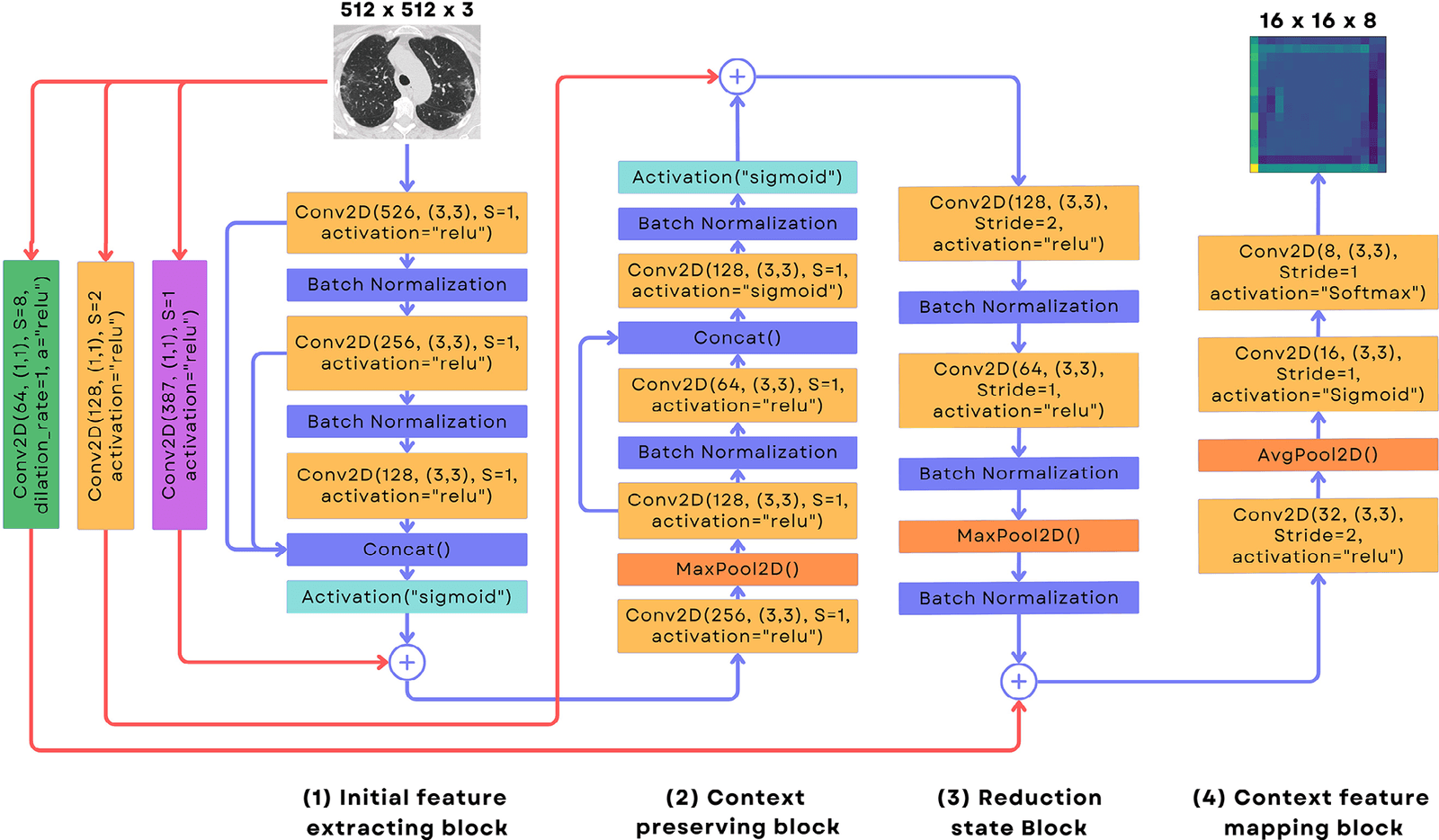
Architecture of the proposed deep learning feature extraction model with initial feature extracting, context preserving, reduction state, and context feature mapping blocks
The custom CNN extracts compression-stable feature maps for subject-sensitive hashing using 14 convolutional layers with residual connections, reducing a 512×512 medical image to a 16×16×8 context feature map.
Publications

Peer-reviewed journal and conference papers

Two journal articles and three conference papers spanning privacy-preserving healthcare AI, computer vision, big-data learning, and Bengali NLP.

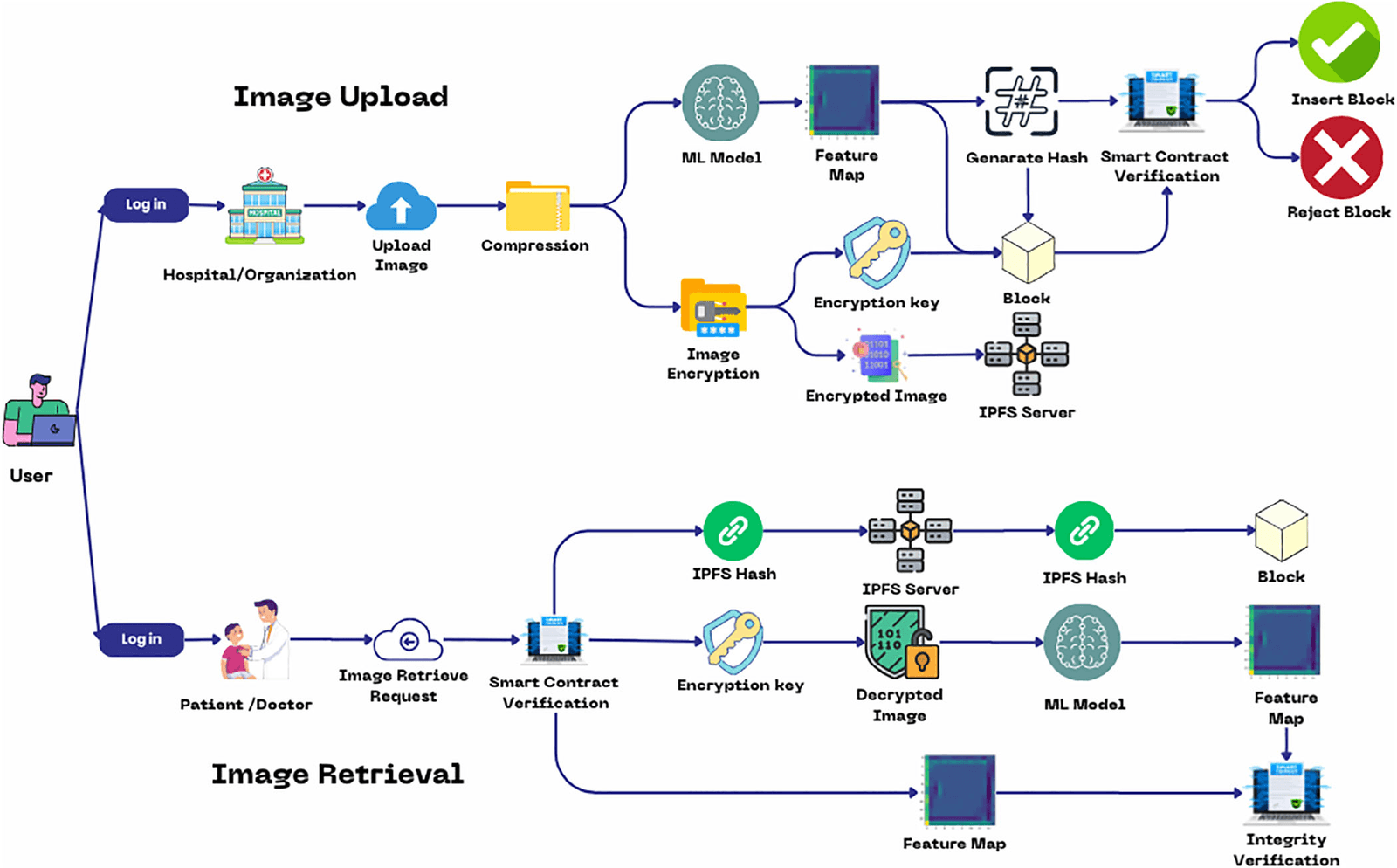
Workflow of the decentralized medical image sharing framework: upload with feature hashing and encryption, retrieval with smart-contract verification
Journal ArticleFirst author2025

Decentralized Medical Image Sharing: A Blockchain Based Approach with Subject Sensitive Hashing for Enhanced Privacy and Integrity

IET Blockchain (Wiley), Vol. 5, e70009

Yeasir Arafat, Abu Sayem Md. Siam, Md Muzadded Chowdhury, Md Mehedi Hasan, Sayed Hossain Jobayer, Swakkhar Shatabda, Salekul Islam, Saddam Mukta

A blockchain framework for secure medical image sharing. A custom deep neural network extracts subject-sensitive feature maps that stay consistent across JPEG compression, so content-based SHA-256 hashes survive routine re-encoding. AES-256-GCM encrypted images live on IPFS while hashes and keys are managed on-chain via smart contracts.

98% avg

Integrity correctness

3 (86K+ images)

Datasets validated

+10 pts

vs ResNet50 baseline

BlockchainDeep LearningIPFSAES-256Subject-Sensitive HashingHealthcare
DOI: 10.1049/blc2.70009
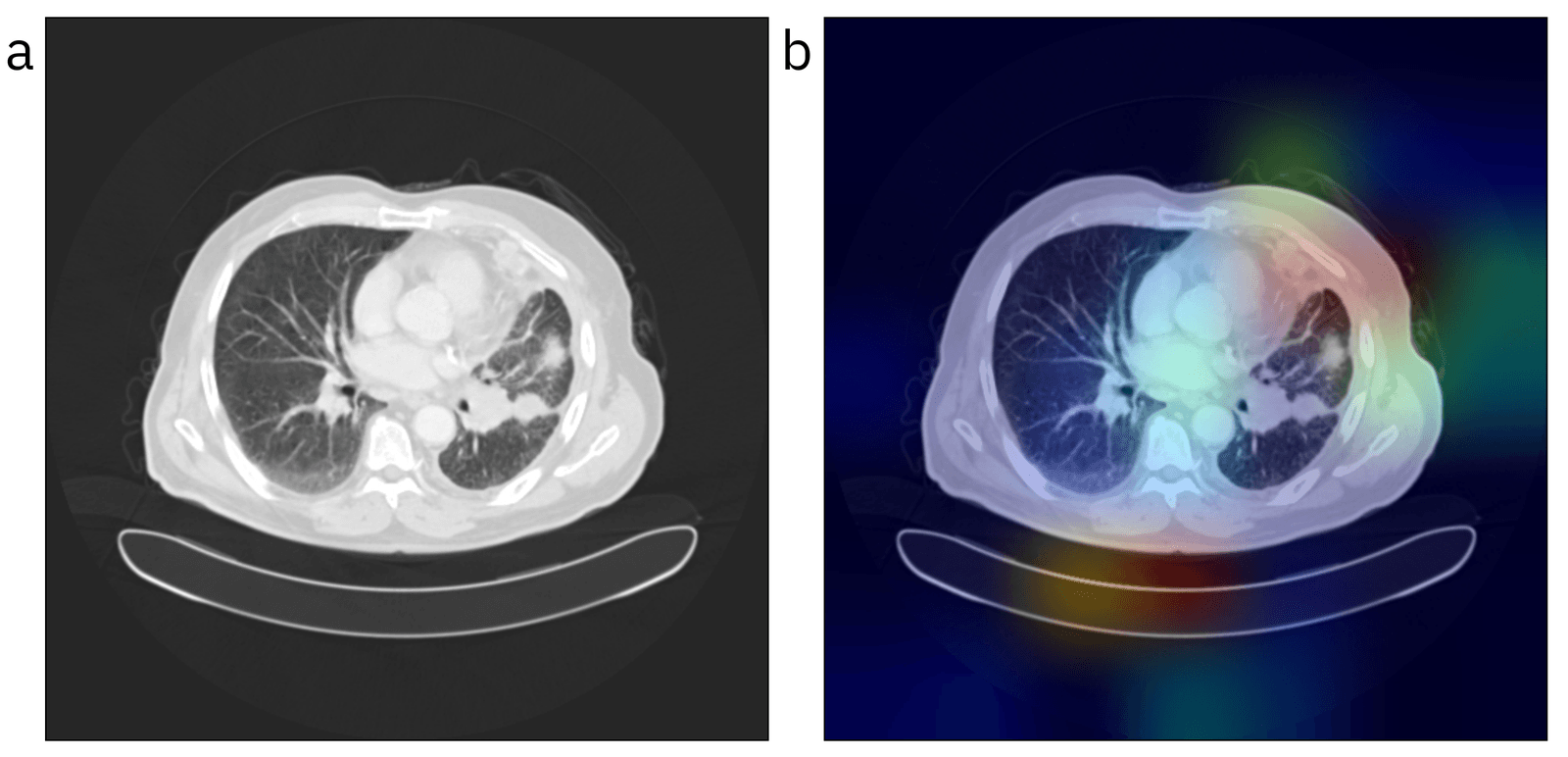
Lung CT scan beside its HiRes-CAM class activation map highlighting the regions FVCM-Net used for a malignant prediction
Journal Article2026

FVCM-Net: Interpretable Privacy-Preserved Attention Driven Lung Cancer Detection from CT Scan Images with Explainable HiRes-CAM Attribution Map and Ensemble Learning

Biomedical Signal Processing and Control (Elsevier), Vol. 112, Part C

Abu Sayem Md Siam, Md. Mehedi Hasan, Yeasir Arafat, Md Muzadded Chowdhury, Sayed Hossain Jobayer, Fahim Hafiz, Riasat Azim

FVCM-Net fuses VGG16 with CBAM attention and trains it via federated learning across multiple institutions so patient CT data never leaves its source. Majority-voting ensembles lift the global model further, and SHAP plus HiRes-CAM attribution maps show clinicians exactly which lung regions drive each prediction.

98.26%

Ensemble accuracy

97.37%

F1-score

93.9% → 97.2%

FL gain via ensemble

Federated LearningCBAM AttentionExplainable AIHiRes-CAMSHAPMedical Imaging
DOI: 10.1016/j.bspc.2025.108719
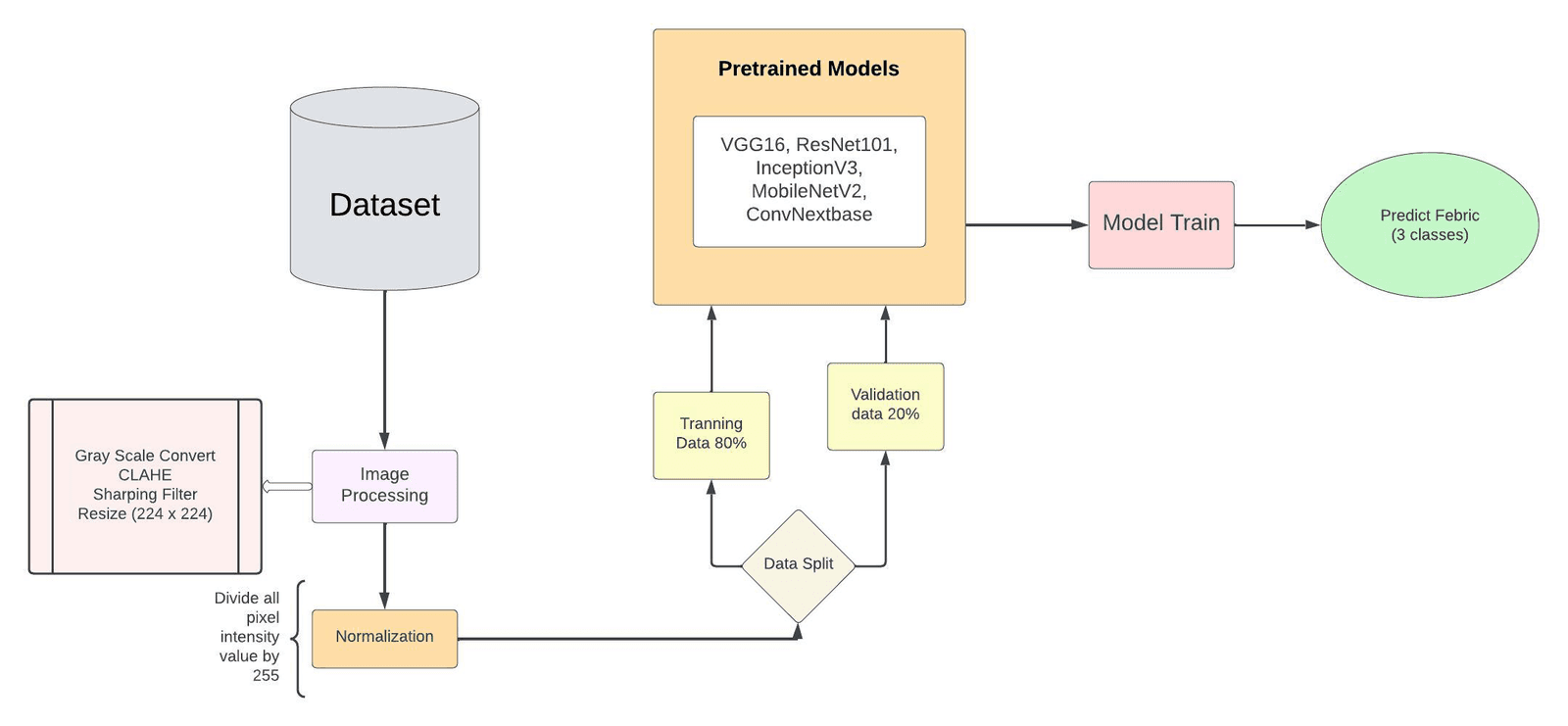
TextileNet experimental design: preprocessing, data split, and five pretrained CNNs classifying fabric into three classes
Conference Paper2023

TextileNet: A Deep Learning Approach for Textile Fabric Material Identification from OCT and Macro Images

26th International Conference on Computer and Information Technology (ICCIT), IEEE

Abu Sayem Md. Siam, Yeasir Arafat, Md. Mushfikur Talukdar, Md Mehedi Hasan, Raiyan Rahman

Benchmarks five pretrained CNNs on two fabric datasets, Optical Coherence Tomography scans and macro photographs, using a CLAHE-and-sharpening preprocessing pipeline. MobileNetV2 identifies cotton, polyester, and wool at near-perfect accuracy on OCT imagery.

99.87%

OCT accuracy

95.17%

Macro accuracy

5 CNNs

Architectures compared

Computer VisionTransfer LearningOCT ImagingMobileNetV2
DOI: 10.1109/ICCIT60459.2023.10441457
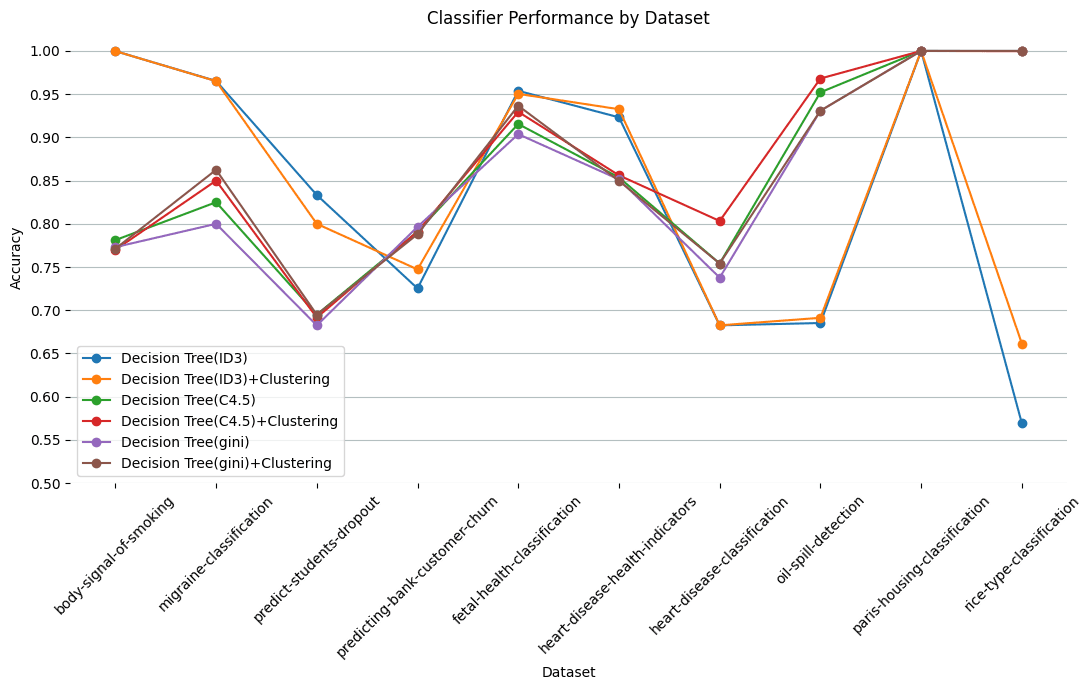
Line chart comparing decision-tree classifier accuracy before and after cluster-based labeling across ten datasets
Conference Paper2023

Clustering as a Catalyst for Big Data Classification (CC-BC)

26th International Conference on Computer and Information Technology (ICCIT), IEEE

Mithun Halder, Shayanta Shopnil, Yeasir Arafat, Md Muzadded Chowdhury, Sayed Hossain Jobayer, Dewan Md. Farid

Builds classifiers from instance similarity instead of expert-annotated labels: K-means clusters big datasets, cluster assignments become training labels, and decision trees, naive Bayes, and ensembles train on top. Accuracy improves across most of the ten Kaggle datasets tested, cutting the labeling bottleneck.

10

Datasets evaluated

253K instances

Largest dataset

DT, NB, ensembles

Classifier families

Big DataClusteringEnsemble LearningSemi-Supervised
DOI: 10.1109/ICCIT60459.2023.10441188
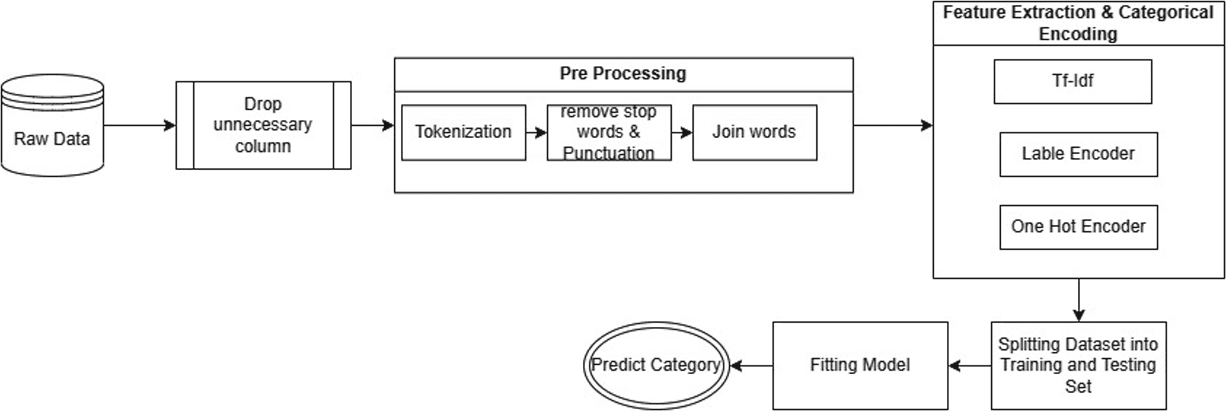
Bangla news classification pipeline: preprocessing, TF-IDF feature extraction, encoding, and model fitting
Conference Paper2023

Bangla News Classification Employing Deep Learning

International Conference on Intelligent Systems and Data Science (ISDS), Springer CCIS 1949, pp. 155–169

Abu Sayem Md. Siam, Md. Mehedi Hasan, Md. Mushfikur Talukdar, Md. Yeasir Arafat, Sayed Hossain Jobayer, Dewan Md. Farid

Classifies 40,000 Prothom Alo news articles into eight categories, comparing decision trees and naive Bayes against dense neural networks and a hybrid Bi-LSTM + Bi-GRU recurrent model over TF-IDF features. Deep models reach roughly 90% accuracy on this low-resource Bengali task.

90% (DNN)

Best accuracy

89%

Hybrid RNN

40K articles, 8 classes

Corpus

Bengali NLPText ClassificationBi-LSTMBi-GRUTF-IDF
DOI: 10.1007/978-981-99-7649-2_12
Achievements

Competitions, scholarships, and recognition

A compact record of academic excellence, AI contests, programming, and project-show results.

B.Sc. in CSE, United International University

Summa Cum Laude

CGPA 3.94 / 4.00

UIU Intra-University AI Contest

Runner-Up

Fake news detection using ML

ML Olympiad - CO2 Emissions Prediction

8th Place

TF User Group North Bengal

CUET ETE Day 2023 - ML Competition

4th Place (Public)

Competitive ML challenge

UIU Coder of the Month (Dec 2022)

3rd Place

UIU CSE Dept. and Computer Club

CSE Project Show Fall '21 - DBMS

2nd Runner-Up

Database management system

Academic Excellence Scholarships

Full and partial

100% x 6 trimesters, 50% x 1, 25% x 4

Codeforces Competitive Programming

Rating: 1220

Pupil rank

Research is most useful to me when it changes how a system behaves in the real world.

Yeasir Arafat

Interested in a research discussion?

I am open to collaborations around AI, security, and practical applied systems.

Start a conversation